


 Clinically reviewed by Liz Marsh
MRI Clinical Lead
Brain MRI with Contrast: When is Gadolinium Needed?
A brain MRI scan with contrast (a special dye) is the gold standard of magnetic resonance imaging for some brain conditions. Here, we’ll explore how it works and when it’s needed.
Understanding brain MRI with contrast
What is brain MRI and how does it work?
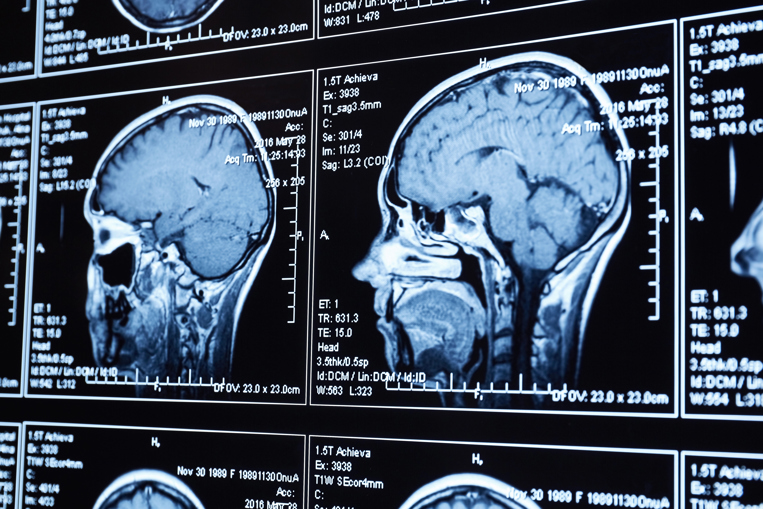
Brain MRI, also known as head MRI, refers to magnetic resonance imaging of the brain and its surrounding structures.
This imaging test uses a powerful magnet and radio waves to create detailed images of the inside of the body. As no ionising radiation is used, it’s safe for pregnant women if clinically justified by your Doctor.
A helmet-like device called a brain MRI coil is placed around the head. A strong magnetic field is created around the patient while gentle pulses of radio waves are passed through them. This creates multiple 2D grayscale cross-sections through the head.
This process enables MRI to create images with high contrast resolution that show subtle differences in tissues.
Role of contrast agents in brain imaging
Contrast media enhance scan images by making the differences within and between tissues more obvious. Using a contrast agent can help catch early signs of brain disease or subtle signs of brain damage that are harder to detect with non contrast MRI.
Gadolinium: the key contrast agent
What is gadolinium and why is it used?
Gadolinium is a rare earth metal. It affects the properties of protons in water molecules inside tissues. Tissues containing gadolinium appear brighter on MRI.
Is gadolinium the only option for contrast?
There’s currently no alternative MRI contrast agent to gadolinium. However, if you have an allergy, your doctor may recommend non contrast MRI that uses different techniques to improve image quality.
When is gadolinium needed for brain MRI?
A non contrast MRI is often the first line of imaging and can answer many clinical questions without the need for contrast.
Brain MRI with gadolinium contrast is recommended to detect different conditions affecting the brain, including multiple sclerosis, tumours, inflammation and infection.
Identifying MS active lesions and tumour enhancement
MRI with gadolinium can diagnose active multiple sclerosis (MS), a degenerative brain condition, by identifying active areas of disease. MS can still be seen on non contrast MRI, but contrast is required to identify active areas of disease (plaques).
The brain is usually protected by a structure called the blood–brain barrier, which stops gadolinium entering the brain. When there are active areas of MS, it becomes leaky, allowing gadolinium to pass through.
Gadolinium-enhanced MRI can also help assess brain tumours by revealing the blood vessels supplying a tumour. This is important for determining how well drugs can penetrate the tumour to destroy cancerous tissue.
Evaluating infections and other abnormalities with MRI
Gadolinium makes areas of infection and inflammation appear brighter on MRI images. This makes it easier to detect brain abscesses, bacterial meningitis and encephalitis.
Preparation for a contrast MRI of your brain
How to prepare before your scan
You’ll be asked not to eat for a certain number of hours before your scan. This means not eating or drinking anything other than water.
Before your scan, you’ll be asked to remove all metal objects from your body eg hair accessories, piercings and clothing with metal detail. You may need to change into a hospital gown.
What to expect during the procedure
During your scan, gadolinium contrast will be injected into a vein. You’ll be asked to lie flat on your back on a patient table, which will slowly slide into the tube of the MRI machine.
You’ll need to remain completely still during your scan. You’ll hear loud banging, knocking and clicking sounds – these are the normal sounds of the MRI machine.
If you struggle with enclosed spaces or are worried about MRI scanner noises, let your care team know. They will give you ear plugs or suggest having an open MRI or wide bore MRI scan.
After your scan, you’ll need to remain at the scanning facility for around 15-20 minutes incase you develop an allergic reaction to the gadolinium. We ask you to drink lots of water after your scan to help flush out the contrast.
Safety, risks and gadolinium side effects
If you have poor kidney function, for example, due to chronic kidney disease, you shouldn’t have a contrast MRI. Contrast places greater strain on the kidneys as it’s cleared from the body.
If you have normal kidney function, most gadolinium contrast will leave your body via your urine within 24 hours.
Very few people have an allergic reaction to gadolinium. If it happens, it’s usually within an hour of the gadolinium injection, and is mild and easily treated.
Some people develop mild side effects to gadolinium that usually resolve within a few hours eg headache, nausea and vomiting. If your symptoms continue or get worse, it is important you seek medical attention.
Small amounts of gadolinium can be retained in the soft tissues of the body, but there is no evidence of any harmful effects of this. We use the safest types of gadolinium contrast at InHealth.
If you are pregnant or breast feeding please tell your referrer and care team before receiving any injection.
Get peace of mind with brain MRI
If you’re concerned about unexplained symptoms and think you may have a neurological condition, Vista Health is here to help.
Simply book a private GP consultation, and one of our experienced GPs will discuss your symptoms and concerns to determine if you need a private MRI scan with contrast.
Alternatively, if you already have a referral letter from a doctor, you can email this to our team, and we can help you arrange your private MRI scan at one of our nationwide clinics.
Before your contrast MRI, you may need to have a kidney function blood test, which you can also arrange with Vista Health.
Sources
https://my.clevelandclinic.org/health/diagnostics/22966-brain-mri
https://www.mayoclinic.org/tests-procedures/brain-mri/about/pac-20582237
https://www.cuh.nhs.uk/patient-information/gadolinium-contrast-aftercare/
https://pmc.ncbi.nlm.nih.gov/articles/PMC12384406/
https://www.radiologyinfo.org/en/info/safety-contrast
https://pmc.ncbi.nlm.nih.gov/articles/PMC9399663/
https://www.msaustralia.org.au/news/use-gadolinium-mri-scans-ms
https://mstrust.org.uk/a-z/magnetic-resonance-imaging-mri
https://www.insideradiology.com.au/gadolinium-contrast-medium/