

Clinically reviewed by Peter Kabogoza
National Clinical Lead - Ultrasound
Elbow Ultrasound: Tennis Elbow vs Golfer’s Elbow
Elbow joint pain is often caused by joint inflammation, specifically inflammation of the tendons. This can cause tennis elbow (lateral epicondylitis) or golfer’s elbow (medial epicondylitis).
Treatment varies depending on which condition you have, so an ultrasound for elbow pain can help you get a definitive diagnosis.
Let’s explore what these conditions are, how they’re treated, and how an elbow ultrasound scan can help with diagnosis.
Understanding elbow anatomy and common conditions
To understand what a private elbow ultrasound scan can reveal about your elbow joint, it helps to explore the basic anatomy of your elbow.
Structures of the elbow joint
Your elbow joint is a hinge made by your upper arm bone (humerus) and 2 lower arm bones (ulna and radius).
Your joint contains ligaments that attach the humerus to the ulna and radius. Flexor and extensor tendons attach your arm muscles to your elbow joint for movement.
Your elbow also contains bursae – small fluid filled sacs that cushion the elbow joint. Nerves including the radial nerve, median nerve and ulnar nerve also run through your elbow.
Pain in the elbow region can be caused by damage to these soft tissues. E.g tendon tears, ligament tears, olecranon bursitis, joint effusion (fluid buildup in the joint) and nerve compression (which causes nerve pain). It can also be caused by a bone fracture among other causes.
What are tennis elbow (lateral epicondylitis) and golfer’s elbow (medial epicondylitis)?
Tennis elbow and golfer’s elbow refer to inflammation of different tendons in the elbow.
Tennis elbow occurs when tendons on the lateral side of your elbow – ie the outside when your arms are at your side – become inflamed. Golfer’s elbow occurs when tendons on the medial (or inner) side of your elbow become inflamed.
Causes and risk factors of tennis elbow and golfer’s elbow
Activities that contribute to tennis elbow and golfer’s elbow
Tennis elbow and golfer’s elbow are not just sports injuries. Tennis elbow is caused by any activity involving repetitive movements that tense the muscles in your forearm responsible for straightening your hand and bending your wrist.
Golfer’s elbow is caused by activities involving repeated wrist or hand-gripping movements that put strain on your forearm muscles (repetitive microtrauma).
The role of sports, occupation, and lifestyle
Tennis elbow is common in people who play racket sports. Other repetitive activities that increase your risk of tennis elbow:
-
chopping tough foods such as meat
-
putting in screws, painting and using plumbing tools (eg wrenches)
-
using a computer mouse
Golfer’s elbow occurs in people who play golf, racket sports or sports involving throwing (eg baseball and rugby) or pulling motions (eg archery and rowing).
Symptoms and clinical presentation
Typical symptoms of tennis elbow vs golfer’s elbow
Tennis elbow causes elbow pain on the outer side of your elbow that travels into your wrist and hand, especially when you grip objects, shake hands, turn knobs or hold mugs.
Golfer’s elbow also causes elbow pain when performing these activities, but it usually travels from the inner side of your elbow along the inner side of your forearm.
Both conditions can cause discomfort in the elbow and forearm as well as tingling and numbness in your fingers, weakness in your hand and stiffness in your elbow joint.
Overlapping conditions: medial epicondylitis, ulnar nerve entrapment, and distal bicep tear
Golfer’s elbow symptoms overlap with other conditions, including ulnar nerve entrapment and distal bicep tears.
Ulnar nerve entrapment (cubital tunnel syndrome) occurs when the ulnar nerve is squashed due to prolonged bending of the elbow. It can occur alongside golfer’s elbow.
A distal bicep tear also causes elbow pain but comes on suddenly due to an acute injury.
It’s difficult to reach an accurate diagnosis based on symptoms alone. An elbow scan or forearm scan is essential for a comprehensive assessment to confirm diagnosis and the most appropriate treatment.
Diagnosing elbow pain with ultrasound
How ultrasound imaging works for elbow assessment
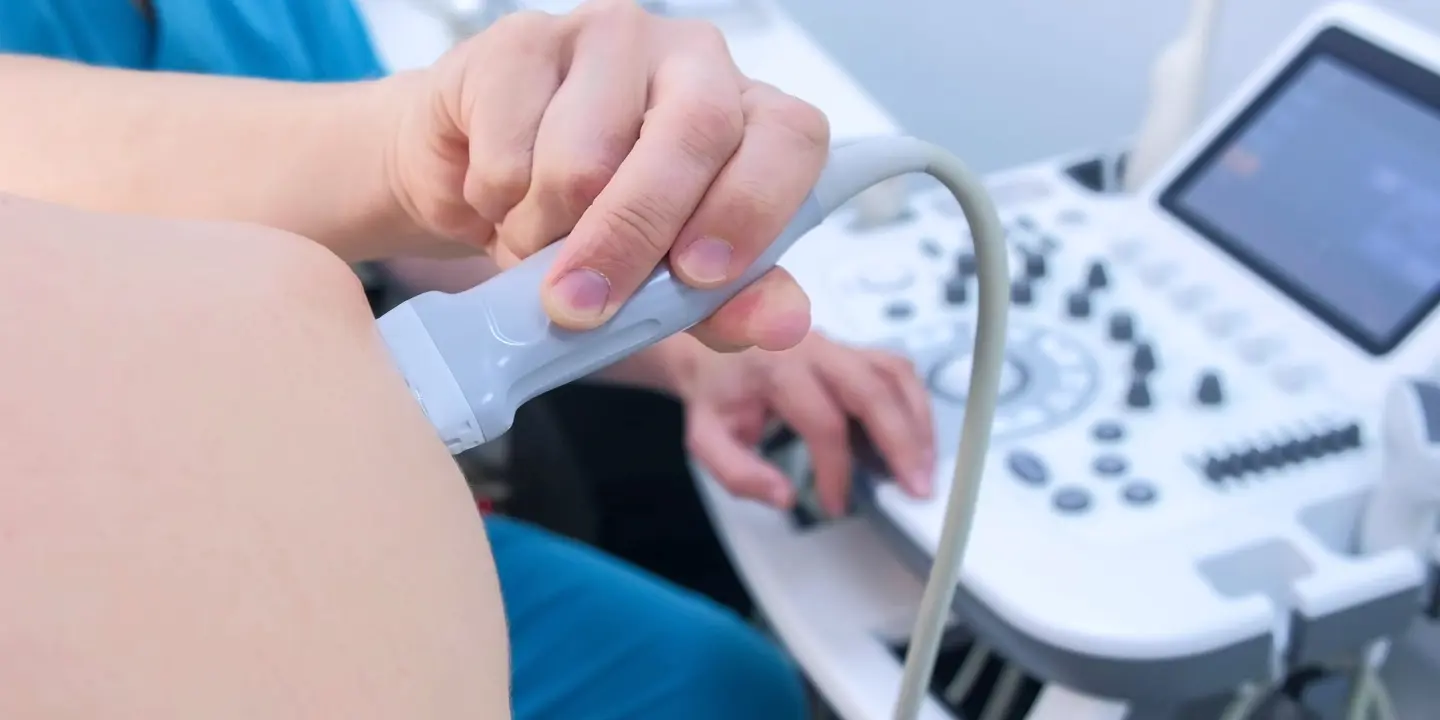
Ultrasound uses high frequency sound waves to create detailed images of the inside of your body in real-time. It’s especially helpful when investigating joints; you don’t need to keep still and your doctor can see how your tissues respond to movement.
Ultrasound waves are released by a handheld probe. They bounce back when they encounter boundaries between tissues, and are detected by the probe. These signals are converted into grayscale images on a screen.
Comparing ultrasound with MRI and X-ray in detecting elbow injuries
Ultrasound is a non invasive imaging technique like MRI and X-rays.
Ultrasound is faster and more cost-effective than MRI, and allows real-time imaging. MRI produces more detailed images, which can aid the diagnostic process by detecting complex or subtle injuries.
X-ray is better suited to detecting bone injuries or arthritic changes rather than soft tissue injuries.
If you've had the all clear from previous imaging results but still have nerve-related issues, you can get a more accurate diagnosis with a private elbow MRI.
Treatment approaches for elbow injuries
Non-surgical treatments: physiotherapy, injections, and bracing
Initial treatment involves rest, applying an ice pack to the area, taking over-the-counter pain relief, and wearing a brace to support your elbow joint.
Physiotherapy is recommended to strengthen your muscles and tendons. As different tendons are affected in golfer’s elbow and tennis elbow, it’s important to get an accurate diagnosis via a forearm ultrasound scan to follow the correct physiotherapy treatment plan.
If these treatments aren’t effective, your doctor may recommend ultrasound guided injections like a cortisone injection (corticosteroid injection) or a platelet-rich plasma injection. These can help the healing process. Early diagnosis may prevent the need for steroid injections.
When is surgery needed for tennis elbow, golfer’s elbow, or related conditions?
Surgery to remove scar tissue is usually only needed if your symptoms have not improved after 6–12 months of less invasive treatments.
Find out why you have elbow pain
Is lifting a cup of tea causing persistent pain in your elbow? Find out what’s going on in your elbow joint. With early detection, you can get back to your usual activities faster.
Book a private elbow ultrasound scan at a nationwide Vista Health clinic for rapid access to the results you need.
Sources
https://www.webmd.com/pain-management/elbow-pain
https://www.webmd.com/fitness-exercise/golfers-elbow-basics
https://teachmeanatomy.info/upper-limb/joints/elbow-joint/
https://www.mayoclinic.org/diseases-conditions/tennis-elbow/symptoms-causes/syc-20351987
https://www.mayoclinic.org/diseases-conditions/golfers-elbow/symptoms-causes/syc-20372868
https://www.mayoclinic.org/diseases-conditions/tennis-elbow/diagnosis-treatment/drc-20351991
https://www.mayoclinic.org/diseases-conditions/golfers-elbow/diagnosis-treatment/drc-20372872