

Clinically reviewed by Peter Kabogoza
National Clinical Lead - Ultrasound
Liver Ultrasound: The First Step for Fatty Liver Diagnosis
Fatty liver disease affects around 1 in 5 people in the UK. Thankfully, it’s reversible, especially if you catch it in the early stages. This is where an ultrasound for fatty liver can make all the difference. This imaging test gives you the chance to get an early diagnosis and take action sooner rather than later.
Here, we’ll explore the basics of fatty liver disease, the benefits of a liver ultrasound scan and what to expect during your private ultrasound scan.
Understanding fatty liver disease
What is fatty liver disease?
Fatty liver disease refers to the build-up of fat in liver cells. It’s also called hepatic steatosis. It causes liver inflammation, which can lead to fibrous tissue, scar tissue and liver damage.
Fatty liver disease often silently damages the liver, with no symptoms for many years. If symptoms occur, they may be subtle eg feeling tired and having some abdominal discomfort.
In more advanced stages of the disease, you may develop jaundice, a swollen abdomen, dark urine, dark stools and/or itchy skin. You may notice that you bruise easily, become forgetful and/or are sometimes confused.
Types of fatty liver disease: NAFLD and alcoholic fatty liver
There are 2 main types of fatty liver disease:
-
Alcoholic fatty liver disease – caused by drinking too much alcohol over many years.
-
Non alcoholic fatty liver disease (NAFLD) or non alcoholic steatohepatitis – caused by health conditions such as obesity or being overweight, type 2 diabetes, high cholesterol levels and/or high blood pressure, as well as following an unhealthy diet and not taking part in enough physical activity.
Although the acronym NAFLD is most common, in 2023, NAFLD was renamed metabolic dysfunction-associated steatotic liver disease (MASLD). It’s the most common type of fatty liver disease and is often reversible with lifestyle changes.
The importance of early diagnosis
There are 4 main stages of NAFLD. At earlier stages, the disease can be stopped or reversed by making healthy lifestyle changes. This makes an early diagnosis essential to protecting the health of your liver and your future quality of life.
In stage 1, there’s no or little scar tissue. In stage 2, there’s scar tissue, but your liver is still working well. At both stage 1 and 2 (mild steatosis), the disease can be completely reversed by following a healthy diet, reducing your body weight and exercising.
In stage 3, there’s significant scar tissue. Healthy lifestyle changes can stop further damage and reverse some of the liver damage.
In stage 4, the liver tissue has become so scarred that it’s changed shape. This is called liver cirrhosis. Even at this point, treatment can reverse some of the liver damage, but without it, the liver can stop working. This causes liver failure, which usually needs treatment with a liver transplant.
Role of liver ultrasound in diagnosis
How an ultrasound detects fatty liver disease
Ultrasound uses high frequency sound waves to create real-time images of the inside of your body – these sound waves are beyond the limit of human hearing.
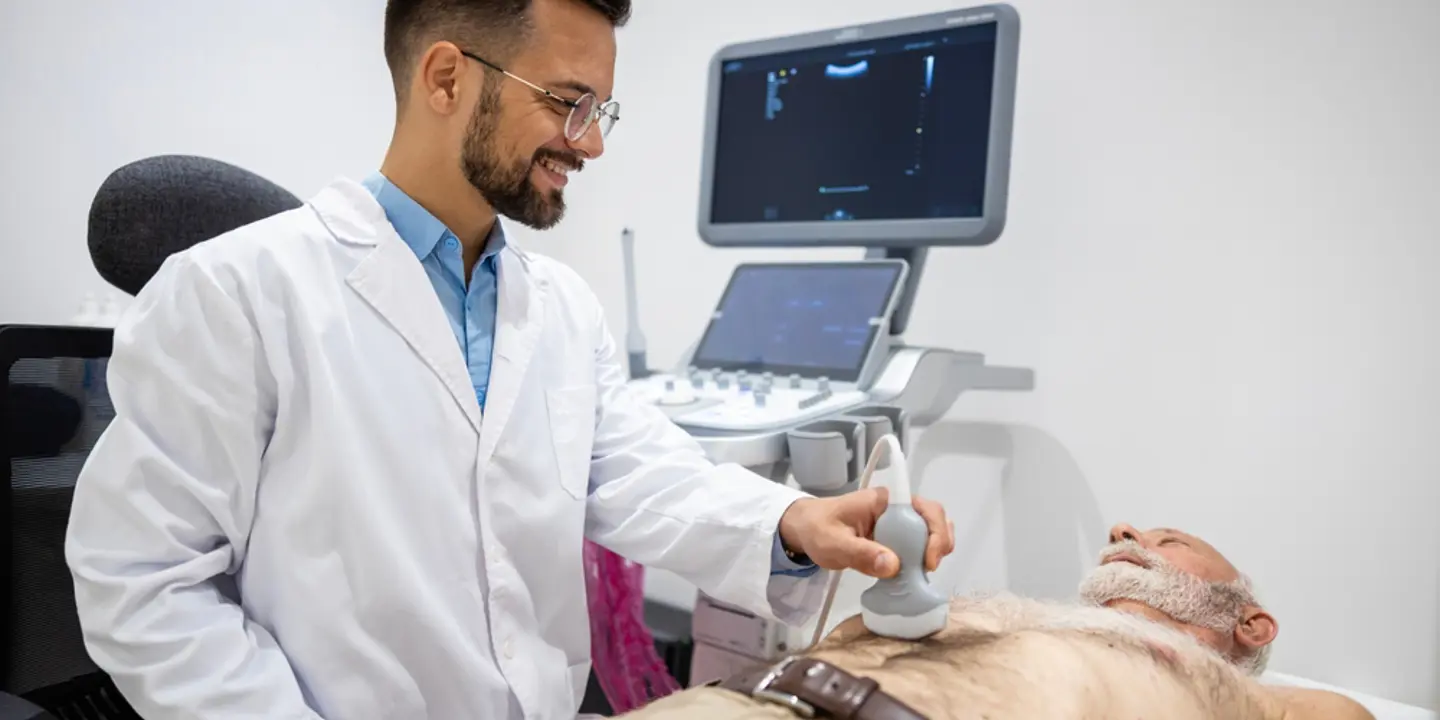
A handheld ultrasound probe is moved over the area to be imaged and emits a painless ultrasound beam. The sound waves are passed into the body and bounce back whenever they encounter areas of tissue that are different densities.
The reflected sound waves – called echoes – are detected by the probe. These signals are sent to a computer and converted into multiple images that are displayed on a computer screen. As over 1,000 echoes can be detected in one second, the images are presented in real time.
An ultrasound for fatty liver disease, also known as a hepatic steatosis scan, can pick up differences between healthy liver tissue and liver lesions or fatty liver. This is because liver damage – such as liver fibrosis and scarring – and fatty tissue have different densities compared with normal liver tissue.
The liver ultrasound procedure
To begin your scan, you’ll be asked to lie back on a patient table. Your abdomen will be exposed and wiped clean.
Then, a gel will be applied to your abdomen. This is to make sure there won’t be any air gaps between the probe and your body when the probe is moved across your abdomen. Air gaps can interfere with the passage of ultrasound waves.
As the probe is moved across your abdomen, you may feel a slight pressure. This doesn’t usually cause any discomfort or pain.
Once your scan is complete, you’ll be given paper towels to wipe the gel away. You can then return to your usual activities.
Liver ultrasound findings
At Vista Health, we aim to give you a detailed report of your scan results within 3 working days. This will be emailed to you and can also be sent to your NHS GP.
The report will be overseen by one of our experienced Consultant Radiologists or ultrasound practitioner, ensuring you receive expert insights.
You can then choose to book a private GP consultation with one of our GPs, who can explain exactly what your results mean for you.
If there are signs of liver problems, they’ll discuss whether further assessment is needed. This may involve referral to a liver specialist for other tests eg blood tests for liver enzymes, doppler ultrasound for blood flow, transient elastography, contrast enhanced ultrasound and/or a liver biopsy.
Advantages of liver ultrasound
Unlike CT scans, a liver ultrasound scan does not expose you to any radiation. You can, therefore, have repeated scans without concern.
What’s more, unlike a CT scanner or MRI machine, you will not be placed in an enclosed environment during your scan – ultrasound scanning uses a handheld probe.
As the images are created in real time, you don’t need to stay perfectly still during your scan. And compared to CT and MRI, liver ultrasound is fast, taking around 30 minutes.
Get your liver health on track
Concerned you may have a fatty liver? Want to protect your liver health for years to come? Get expert insights into your liver health status with Vista Health.
Simply self-refer and book your private ultrasound scan at one of our nationwide imaging clinics at a date and time that suits you.
Sources
https://www.nhs.uk/conditions/non-alcoholic-fatty-liver-disease/
https://my.clevelandclinic.org/health/diagnostics/liver-ultrasound