


Magnetic resonance imaging provides the most detailed images of the inside of your body. For larger patients concerned about having an MRI scan, there are now options using specially designed MRI scanners.
Weight limits vary depending on the manufacturer of the machine. Here, we’ll explore the MRI weight limit in the UK for different MRI machines and how wide bore and open MRI offer greater comfort for larger patients and those suffering from claustrophobia or anxiety.
First, it helps to understand how MRI works.
How does an MRI scan work?
An MRI scan produces highly detailed images of the inside of your body, particularly soft tissues, organs and bones. Unlike X rays or CT scans, MRI does not use ionising radiation. Instead, it uses powerful magnets and radio waves.
During an MRI scan, a magnetic field temporarily affects tiny particles called protons within the body’s tissues. Radio wave pulses alter their position, and as they return to normal, they release energy.
This energy is detected by the scanner and converted by a computer into detailed cross-sectional images, sometimes in 3D. The scan is performed by a Radiographer, and the scan procedure can last from 15 minutes to 90 minutes, depending on the body part being scanned.
In some cases, a special dye called a contrast agent is needed to help improve image quality. For MRI, the contrast agent is a rare-earth metal called gadolinium. This is usually injected into a vein in the arm and improves the contrast of images.
The high-resolution images created by MRI mean it can help diagnose the cause of unexplained symptoms by providing visual evidence of disease or damage. MRI can detect tumours, brain diseases, abnormalities in blood vessels, and damage to the spine, joints, tendons, cartilage and organs, among other health conditions.
MRI scanning challenges for larger patients
An MRI machine is a large, tube-shaped structure. It is about 122cm (4 feet) long. A patient lies down on the MRI scanner table, which slides into the tube. Depending on the body part being scanned, the patient is either slid in head-first or feet-first so that the body part being scanned is in the centre.
The tube is called a bore. Both the bore size and the table weight capacity can present challenges for larger and obese patients.
The physical limitations of traditional MRI machines
Traditional MRI machines used in hospitals have a bore size of 60cm in diameter and a weight limit of 159kg (subject to manufacturer’s specification). For larger individuals, this space can feel more enclosed during their scan. This can make the scan experience uncomfortable and worsen claustrophobia. In some cases, individuals may not physically fit inside the machine.
Safety concerns during scans
For larger individuals, having an MRI scan in a traditional MRI scanner carries a slightly higher safety risk because of the smaller MRI bore diameter. Physical contact between a person’s body and the bore can cause burns due to the heat created by the MRI scanner when in use. A wider bore would protect against this. The wider bore also enables us to provide padding between you and the bore to make you more comfortable and prevent burns.
MRI scanners for plus size patient comfort
If you need a plus size MRI scan, there are several options you can discuss with your doctor so you can decide which to choose. They’ll explain which MRI scanner is most suitable, taking into consideration your symptoms and which body part needs scanning.
MRI scanners can be open or closed.
A traditional MRI machine is a closed scanner. There are no side openings – only an opening at the top and the bottom of the tube. In contrast, an open MRI scanner can have openings on up to 3 sides.
Wide bore MRI scanners
A wide bore MRI scanner is a type of closed MRI machine. The bore size is wider than a traditional MRI scanner at 70cm in diameter. This gives larger or obese patients 10cm more space. It may not sound a lot, but it makes a big difference.
These scanners also generally have a higher weight limit of 250kg (subject to manufacturer’s specification), compared to 159kg for standard MRI scanners.
As wide bore MRI scanners are a closed system, they can create clearer images than an open MRI scanner. This is because MRI uses magnetic fields to create images of the inside of the body, and a closed scanner allows stronger magnetic fields to be used.
Magnetic field strength is measured in Teslas. Most MRI scanners use a magnetic field strength of 0.2–3T. A closed MRI system can operate at the higher end, around 1.5-3T.
Open MRI scanners
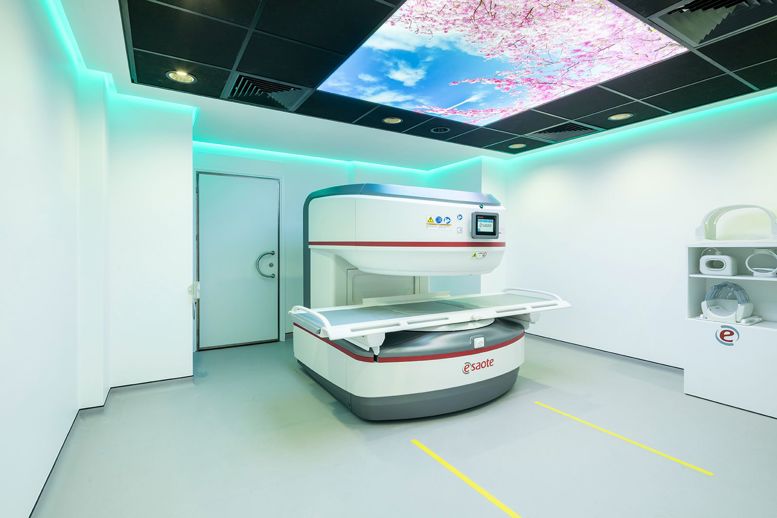
Open MRI scanners allow patients to see the room around them. This is either because there are more openings around the patient or the position the patient is placed in.
In a traditional open MRI scanner, you lie down on the patient table, but you are not slid into a tube. Instead, the structure of the machine is more open with openings usually at the top, bottom and one side.
In open upright MRI scanners, you will be enclosed on 3 sides, but you can sit upright with an open front view. Often, you can also watch television on an upright scanner.
Both of these types of open MRI scanners assist patients who feel anxious, especially those who have claustrophobia.
However, open MRI scanners use less powerful magnetic fields than those used in closed MRI scanners. The maximum field strength for an open MRI scanner is usually 0.6T. This means the images they create are less detailed than those created during a closed MRI scan.
Although open scanners can help patients with anxiety and claustrophobia, they cannot always be offered for obese patients due to scanner weight limits (approximately 200kg depending on scanner specification).
How to access a plus size MRI scan
If you’re a larger individual and have a concern about unexplained symptoms, such as pain or discomfort, having a private MRI scan alongside expert clinical analysis can help you get the clarity you need.
To avoid NHS waiting lists for your MRI scan, choose Vista Health. In many cases, you can book a private MRI scan appointment without a referral from a doctor. You’ll be asked to fill in a safety questionnaire with questions about your medical history before your scan.
Once your scan is complete, we aim to send your scan results to you within 3 working days. You’ll receive a report overseen by an experienced Vista Health radiologist.
Book your plus size MRI scan now
To arrange your plus size private MRI scan, simply self-refer on our website and select from one of our nationwide locations offering wide bore and/or open MRI services.